
Dalam arsitektur tradisional acara dan ritel, space was always defined by its physical boundaries—walls, ceilings, and static backdrops. Namun, the advent of tampilan LED latar belakang raksasa has fundamentally rewritten the “spatial grammar” of commercial environments. No longer relegated to being mere “background boards” for information, these massive, modular digital canvases have become the primary architects of atmosphere.
By using seamless splicing and ultra-high resolution, giant LED screens expand spatial boundaries. Lebih-lebih lagi, panoramic content places audiences directly inside the story. Whether on concert stages, auto shows, or luxury stores, spaces become narrative media. Sebagai akibat, physical environments transform into editable storytelling platforms. This article therefore, examines how LED technology guides emotion and vision. Akhirnya, static locations evolve into fully immersive story worlds.
1. From “Background” ke “Environment”: The End of the 2D Backdrop
The most significant shift in spatial grammar is the transition from a flat, two-dimensional screen to a three-dimensional, “enveloping” environment.
The Erasure of Seams
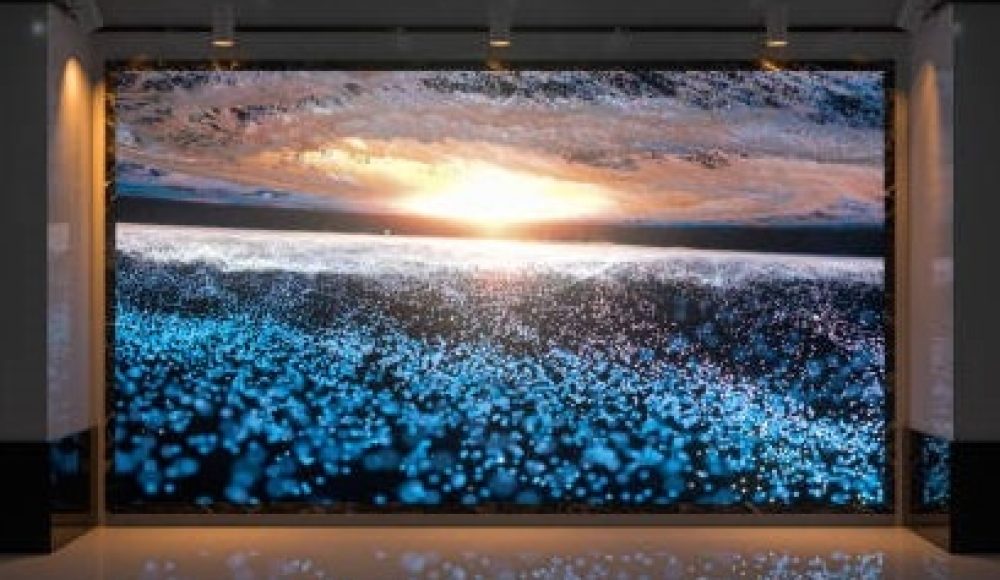
Traditional display technologies were limited by bezels and frames, which constantly reminded the viewer of the screen’s physical presence. Giant background LED displays utilize modular splicing technology that achieves true seamlessness. When a screen stretches across a 50-meter curve without a single visible line, the human eye stops perceiving it as a “display” and begins to accept it as a “horizon.”
Wraparound Visual Fields
By utilizing concave, convex, or right-angle corner modules, designers can create a visual field that exceeds 180 degrees. Ini “peripheral immersion” is crucial for storytelling. When the visual stimulus occupies the viewer’s entire field of vision, the brain stops comparing the digital image to the surrounding physical room, allowing for total psychological “presence” within the digital narrative.
2. The Stage as a Portal: Directing Emotion in Live Performance
In the world of concerts and theater, the stage is no longer a platform for a performer; it is a portal to an “Otherworld.”
Dynamic Scale and Perspective
Giant background LED displays allow stage directors to manipulate the audience’s sense of scale. A performer can appear to be standing on the edge of a cosmic nebula or inside a microscopic cell. Because modern LED controllers support extreme resolutions (8K and beyond), the textures—such as flowing water or crumbling stone—look tangibly real even from the front row.
The Integration of XR and Real-Time Rendering
Hari ini, stage “space grammar” increasingly incorporates Extended Reality (XR). By synchronizing LED backdrops with camera tracking and real-time engines, perspectives stay accurate. Sebagai akibat, the digital background moves naturally with every camera motion. Akibatnya, a strong parallax effect creates the illusion of endless depth. Dengan demikian, a ten-meter stage visually expands into a vast digital landscape.
3. The Exhibition as a Simulator: Redefining Product Interaction
For trade shows and exhibitions—particularly in the automotive and aerospace sectors—the challenge is often “static fatigue.” A car sitting on a carpet is just an object.
Simulated Motion Environments
At premium auto shows, tampilan LED latar belakang raksasa serve as “Environmental Simulators.” By surrounding a vehicle with high-speed, 360-degree footage of a coastal highway or a rugged mountain trail, the display tricks the audience’s vestibular system. Even though the car is stationary, itu “flowing” background creates a dynamic sensation of speed and freedom.
The Narrative Loop
In a museum or historical exhibition, the space is often segmented into a “Narrative Long Scroll.” Rather than reading static plaques, visitors walk alongside a 100-meter LED wall where history “flows” past them. The space dictates the pace of the story; as the visitor moves, the digital environment evolves, ensuring that the information is consumed as an experience rather than a chore.
4. The Flagship Store as a Living Brand Archive
In the retail sector, particularly for “Experience Centers,” the goal is to move the customer from “shopping” ke “inhabiting” the brand.
Itu “Living Skin” of the Store
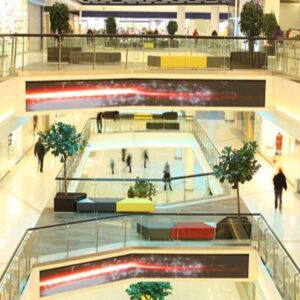
Luxury flagship stores are increasingly using tampilan LED latar belakang raksasa as a “digital skin” for their interiors. Instead of expensive, static marble or wood finishes, the walls become fluid. In the morning, the store can evoke the crisp, white light of a Parisian atelier; by evening, it can shift into a warm, sunset-drenched gallery. Ini “editable architecture” allows the brand to refresh its entire aesthetic without a single day of construction.
Directed Sightlines
Retailers use the brightness and motion of LED displays to choreograph customer movement. High-contrast, moving visuals on a giant background naturally pull the human eye toward the back of the store, effectively eliminating “dead zones” and ensuring that the entire retail floor is utilized.
5. Technical Pillars of Spatial Narrative
To successfully reconstruct a space, itu tampilan LED latar belakang raksasa must meet specific technical benchmarks.
-
Pixel Pitch & Viewing Distance: For flagship stores, a fine pixel pitch (P1.2 to P1.8) is required so that the digital texture remains invisible to customers standing within arm’s reach.
-
Color Depth and HDR: Immersive storytelling relies on “Life-like” warna. HDR10+ and 16-bit color processing ensure that shadows are deep and highlights are brilliant, preventing the “washed out” look that breaks immersion.
-
High Refresh Rates: To prevent “flicker” on smartphone cameras (which every audience member will use), a refresh rate of 3840Hz or higher is essential for viral social media sharing.
-
Low Latency: In interactive spaces, the background must react to user movement or touch in under 20 milliseconds to maintain the illusion of reality.
6. Kesimpulan: The Space that Speaks
The integration of tampilan LED latar belakang raksasa marks the end of “dumb” architecture. We are entering an era where spaces are no longer fixed, but programmed. By mastering this new “Space Grammar,” brands, artists, and exhibitors can transcend the limitations of physical materials.
The space is no longer just a container for a story; it is the story. Whether in energetic stadiums or refined boutique spaces, giant LED technology immerses audiences fully. Karena itu, viewers experience the narrative instead of merely watching it. Looking ahead, the most successful spaces will adapt instantly to creative ideas. Sebagai akibat, every visit becomes a unique and unrepeatable premiere.